| LICENSE | ||
| README.md | ||

Taming The Information Lifecycle
Introduction to the Information Lifecycle
The world is suffering. It suffers from a misunderstanding of facts and information.
Facts are not information. Facts are self-contained while information is not. Facts by themselves have no meaning. They need to be put into context to become meaningful, which then turns them into information.
Information therefore is more like an organism made of facts that changes over time. _In fact _each piece of information has a lifecycle in itself.
Also information does not stay relevant forever. It's relevancy is tightly bound the context the information lives in.
To illustrate let's look at the Task 'Buy Aspirin from pharmacy'
The Information Lifecycle on the living example: 'Buy Aspirin from pharmacy'
'Buy Aspirin from pharmacy' is information. It goes beyond a fact, because it implies that...
-
the action of buying has to be performed
-
it has to be done by (someone)
-
the object that is to buy is Aspirin
-
the place to buy that object is the pharmacy
One can make the following observations
-
All those four points are facts in themselves, which are absolutely meaningless until we put them into the context of an errand that we have to make.
-
Once the errand is done and we actually bought the Aspirin, the information is not relevant any longer.
But what if the pharmacy didn't have Aspirin?
We would now have to process this new information into a new Task 'Buy Aspirin online'.
No biggie, right?
It's just Aspirin, right?
A little bit of Aspirin can't hurt anyone...
Well, it's not that easy.
It's not that easy
Unless you already know right away where to order the thing and can tick off the task 'Buy Aspirin online' in a minute, the new task comes with a couple of implications that might not be as obvious
- The information is not the same anymore: it increased in complexity.
- It didn't come out of nothing: it has an origin. We only consider ordering online because the pharmacy didn't have any.
- How do we keep track of the information's origin? Make the name longer? 'Buy Aspirin online - because the pharmacy didn't have any' ? Wonder how that scales...
- To us it's clear that the next logical step after the pharmacy not having 'Buy Aspirin online' is to go order it online. Someone else might look at 'Buy Aspirin online - because the pharmacy didn't have any' and might ask - "why order it online? Can't we just ask our neighbor? He works in a pharmacy, I'm sure he has some at home."
So now what?
Easy: 'Ask neighbor for Aspirin - because the pharmacy didn't have any - and ordering online might not be necessary' ... right?
I hope at this point it's clear that an innocent little TODO in our list can easily turn into a nightmare of an escape room with no exit.
The Solution
Once the information increases in complexity we need a mechanism that makes it easy for us to keep track of the information lifecycle, it's origin, possible changes in direction, additional resources, et cetera.
OneNote
I honestly don't know how to do that in OneNote. I believe nobody knows how to do that in OneNote. Because it's not possible in OneNote.
Roam
Lets assume we are about to turn 'Buy Aspirin from pharmacy' into 'Buy Aspirin online - because the pharmacy didn't have any' but then remember that we watched this video at some point.
Here is how it looks like in roam...
Steps
Let's turn the TODO 'Buy Aspirin from pharmacy' into a page 'Buy Aspirin from pharmacy'
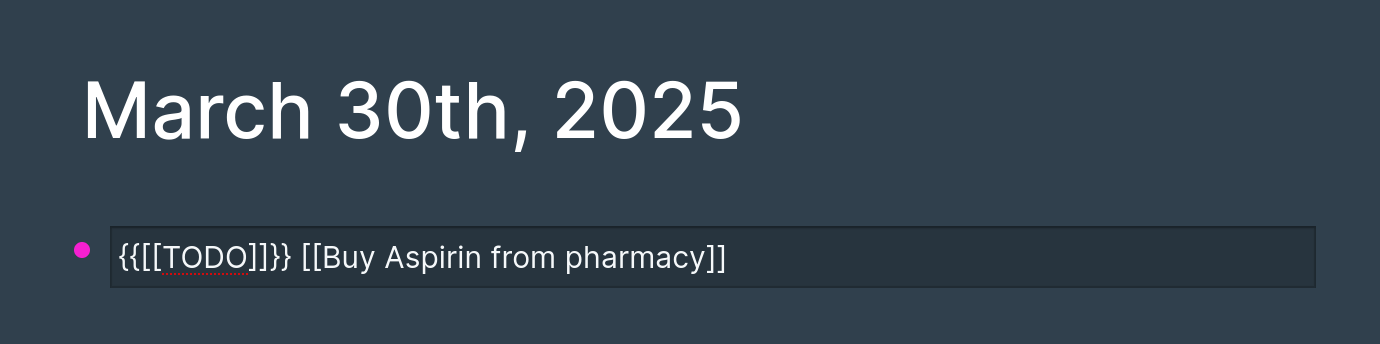
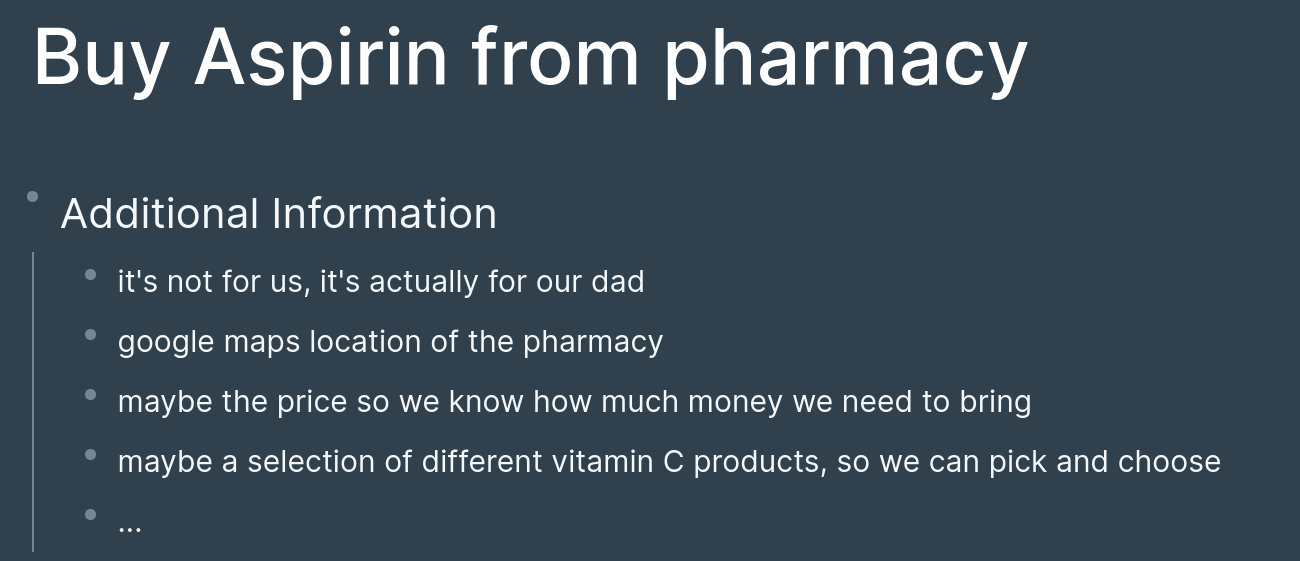
We now add additional information that is relevant to ticking off the TODO
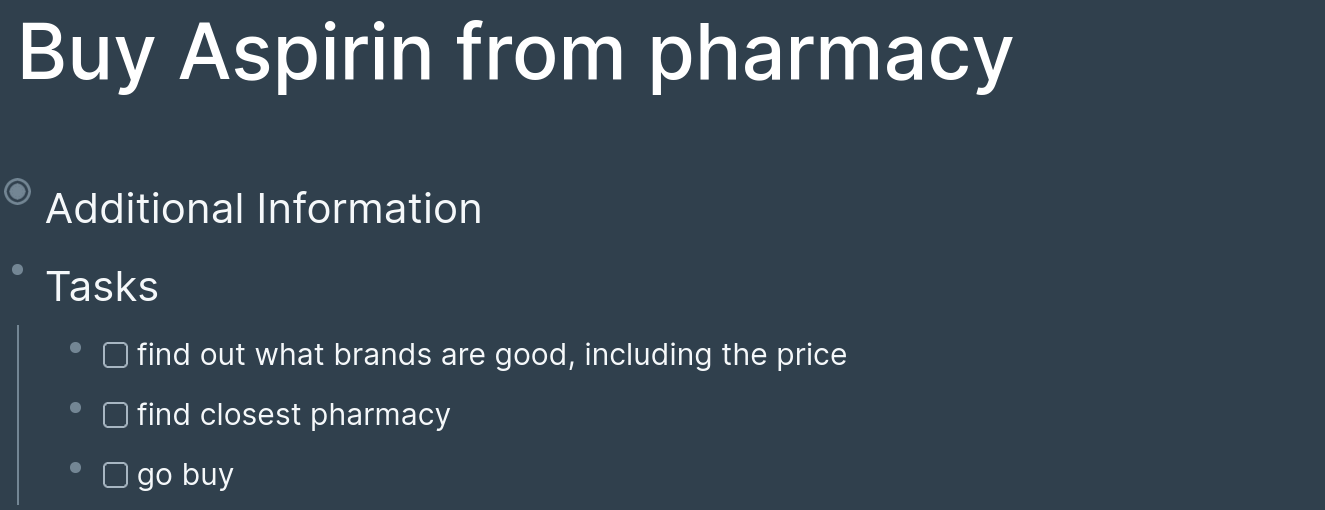
Next we identify what tasks is our small innocent little todo actually made of
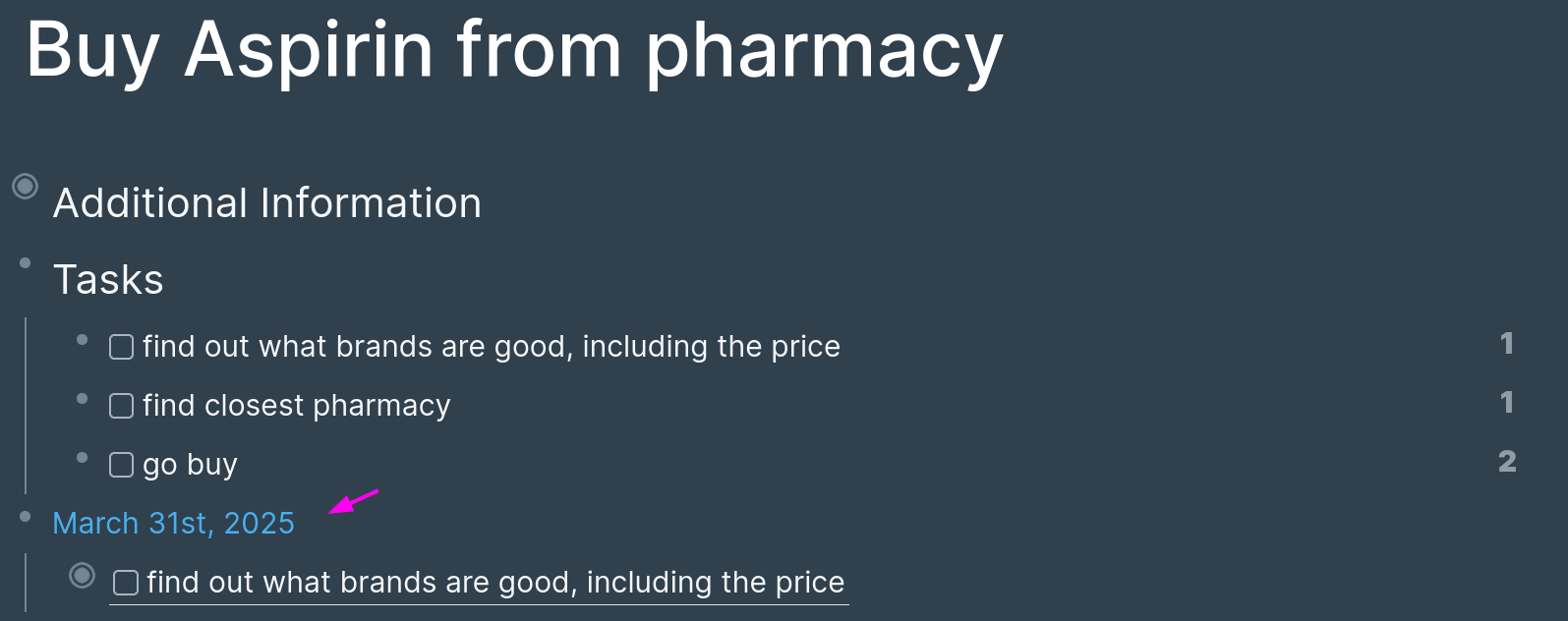
Then we plan out when we are actually going to do each task by organizing block references below the regarding dates inside our task page:
And then we encounter a problem: We live in a small village. We can't just walk to the next pharmacy because there is no pharmacy in our village. We need to ask our mom if she can take us to the city.
So now we write down a question for Mama if she can take us to the city. The next time we see our mama, we ask her if she can take us. So far so good.
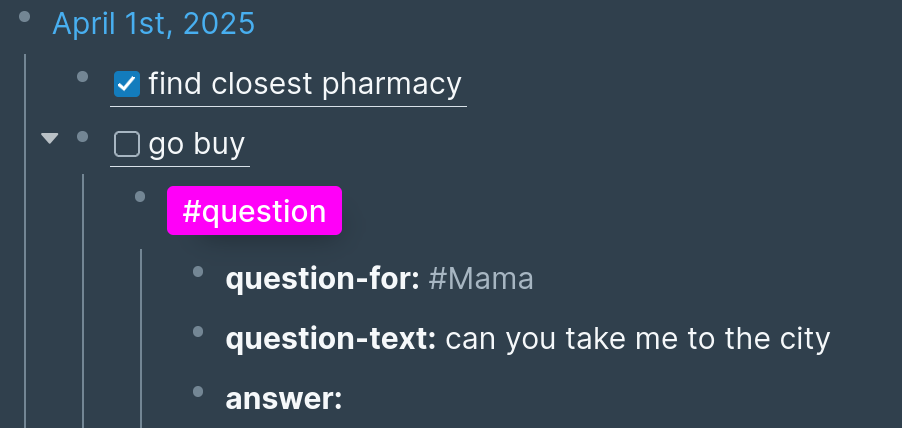
But Mama is not at home right now. When we tried to call her, she didn't pick up the phone and, honestly, in the meantime we just forgot that we have a question for Mama in the first place.
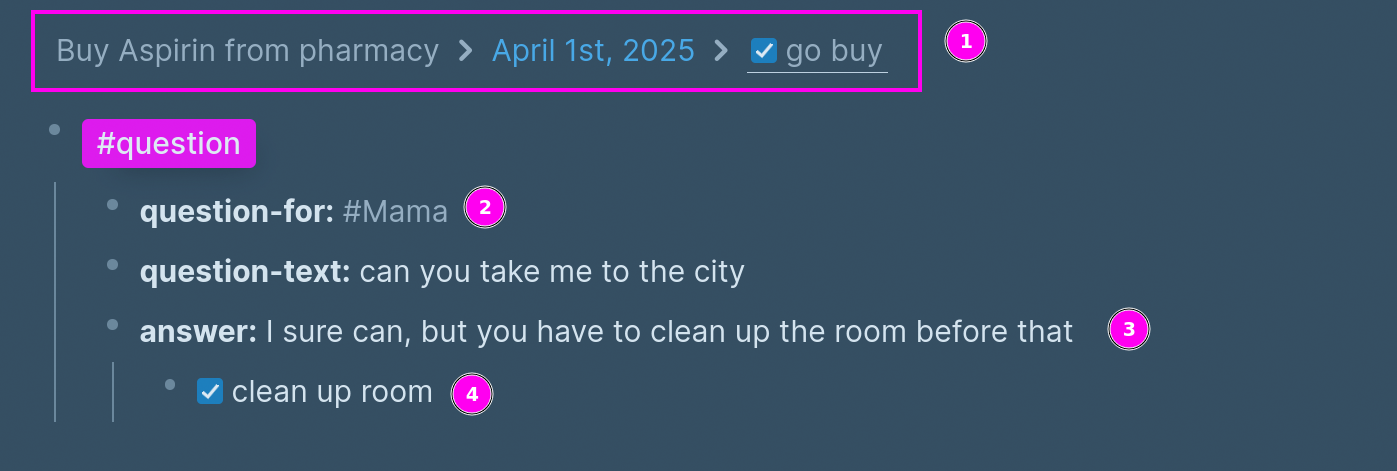
When Mama comes home she tells us that she would love to take us to the city, but we didn't clean up our room in a while and, unfortunately, that is an absolute necessity for children who need Mama's services.
So the question now turns into unexpected subsequent work: "clean up room"
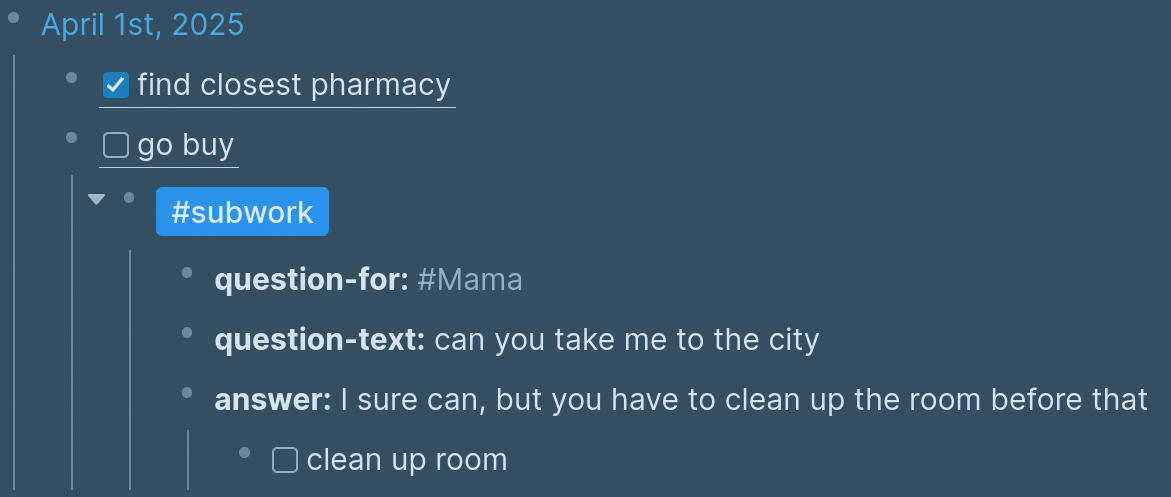
Obviously the next step is to turn the subwork into a solved by actually cleaning up our room
- tick off the subsequent work
- change from "subwork" to "solved"
- tick off parent-todo that led to the question to begin with
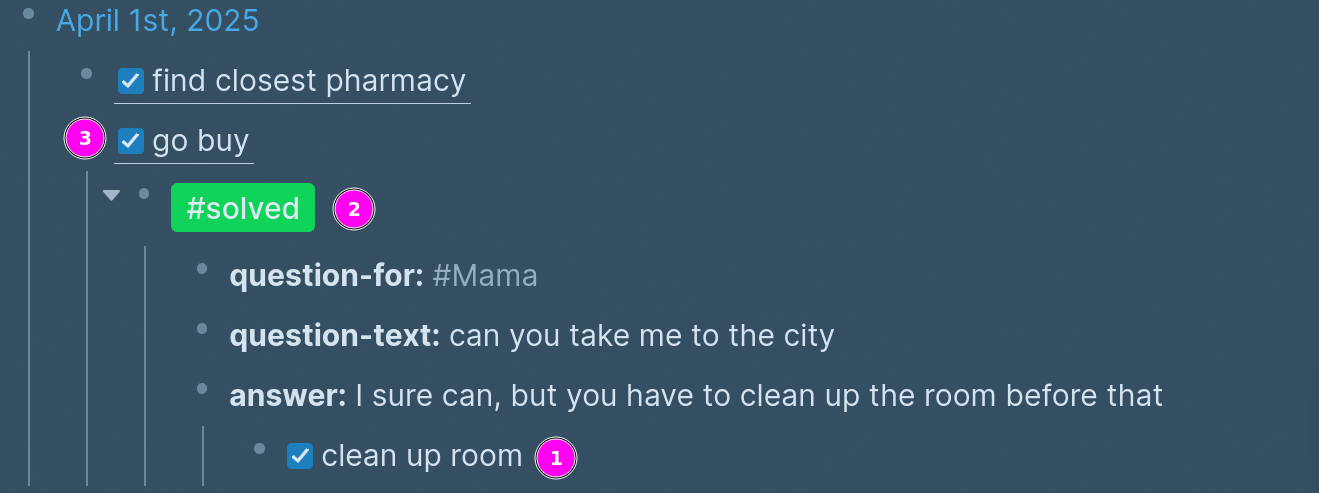
so we can move on with our actual goal: 'Buy Aspirin from pharmacy'
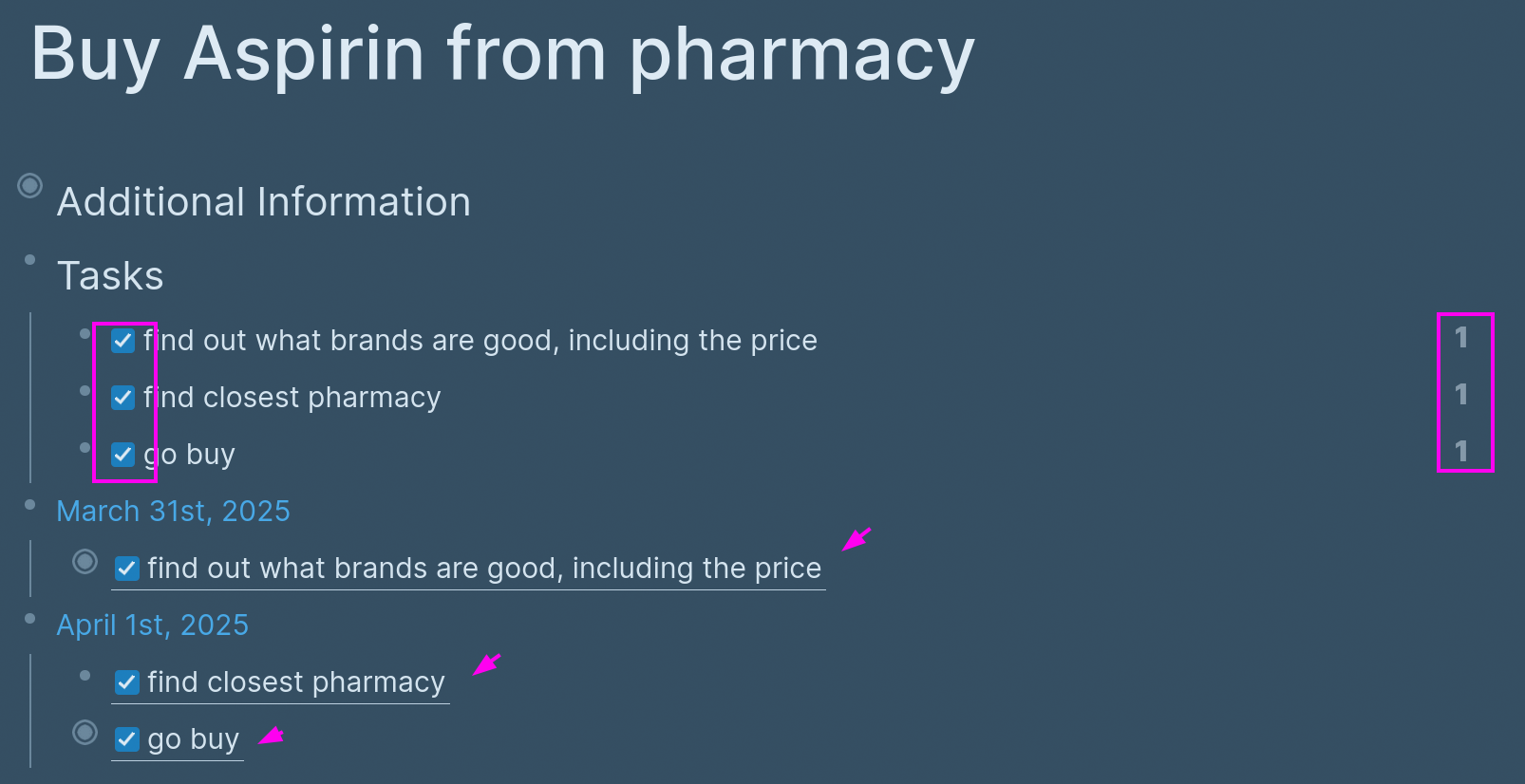
But wait - There's more!
How did we even remember that there was a question to ask towards Mama ?
If we look at the question a little bit closer we find some attribute below.
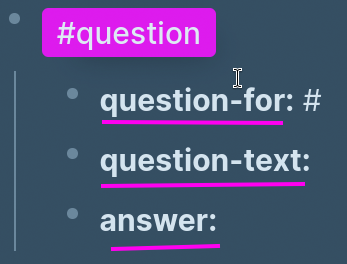
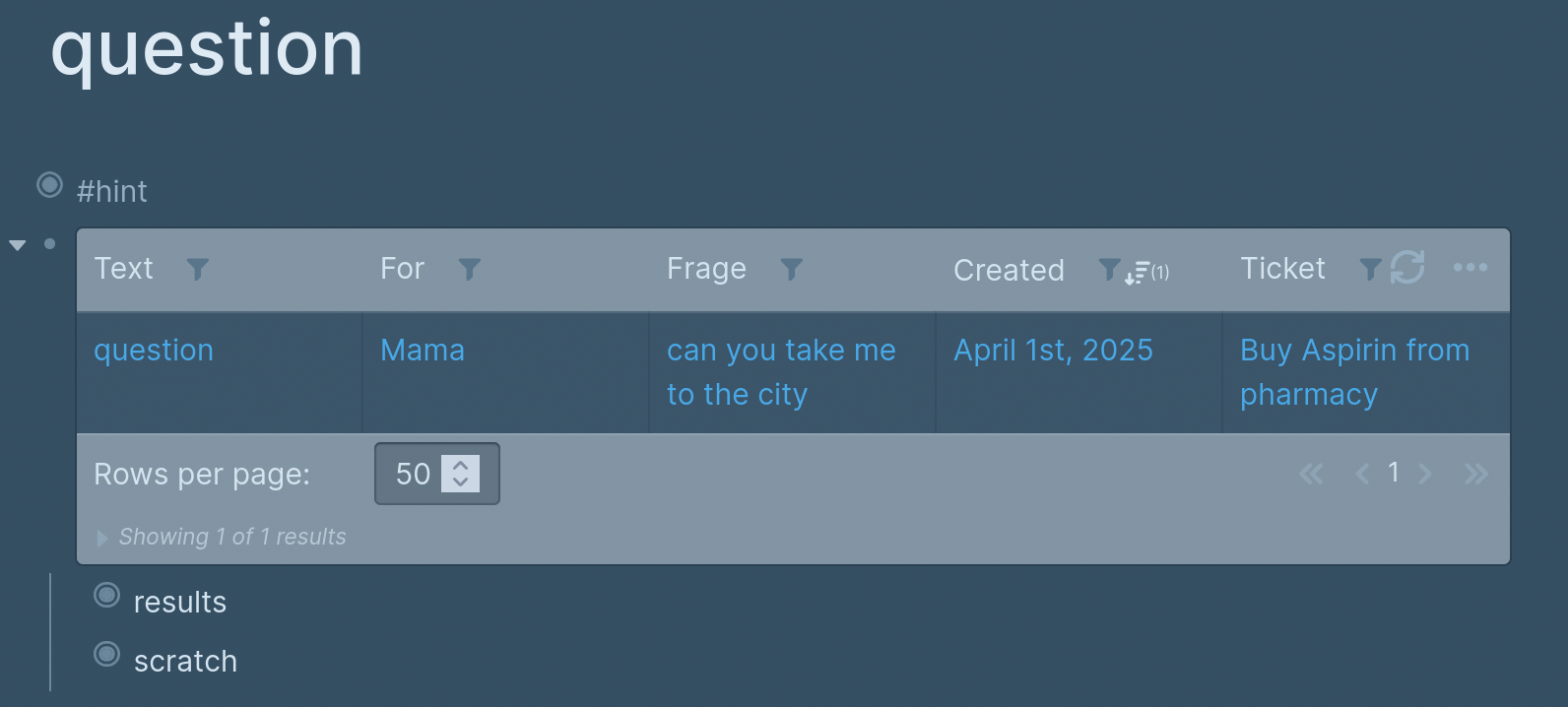
These attributes now help us to create a dashboard for all the questions for our mama and all the subsequent work that we have to deal with, without us having to remember them
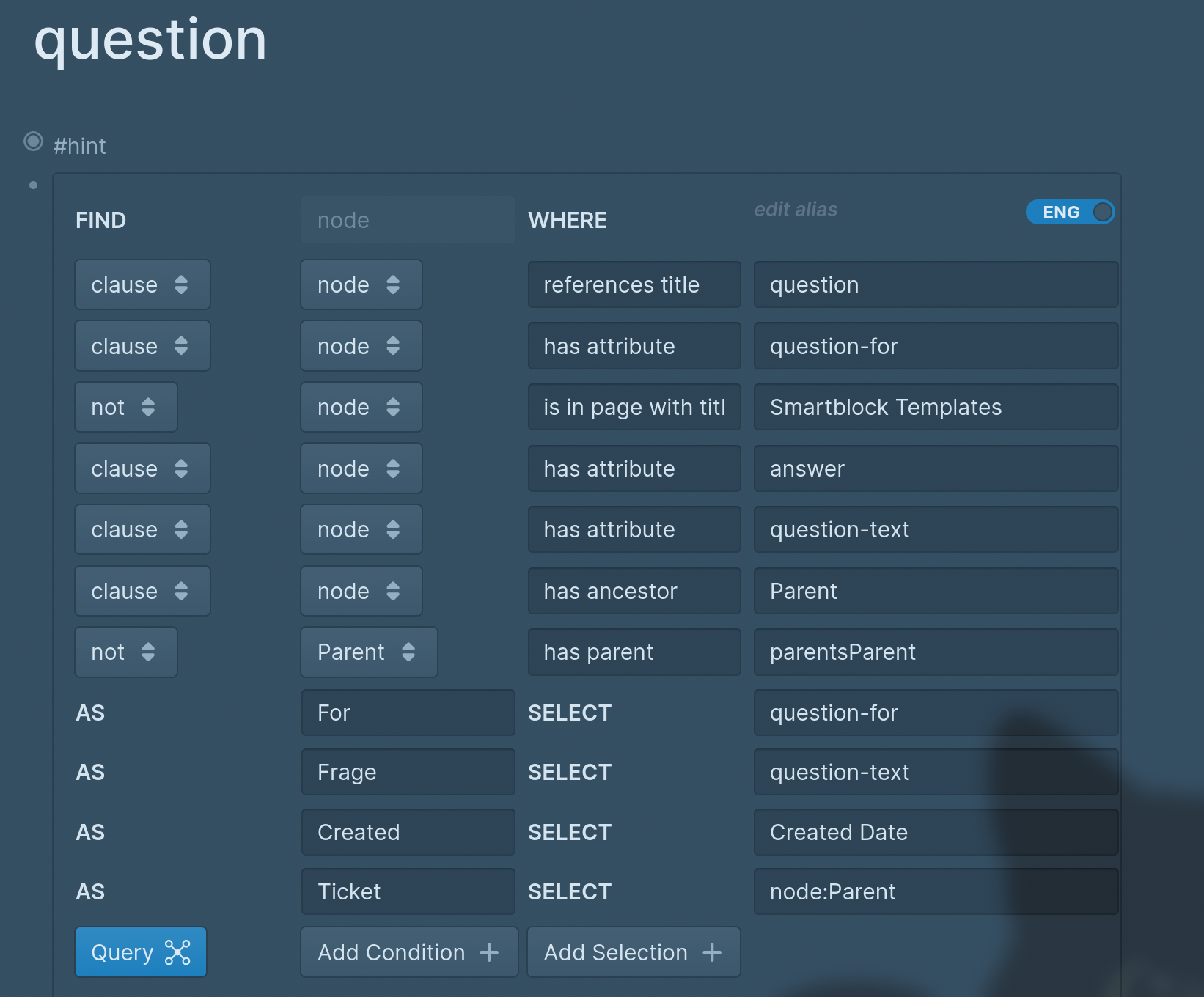
After setting up the {{query block}} the result looks like this
It scales
In the real world the regarding coworker is rarely available in the moment we need him. When he calls us back some time later (can be 1 hour, 1 day or 1 week) we often don't know what we wanted anymore due to the constant context switching that comes with the job.
No longer.
This is all the questions I have to all my coworkers. Each coworker has his own specific dashboards. (See 'Mama' above)
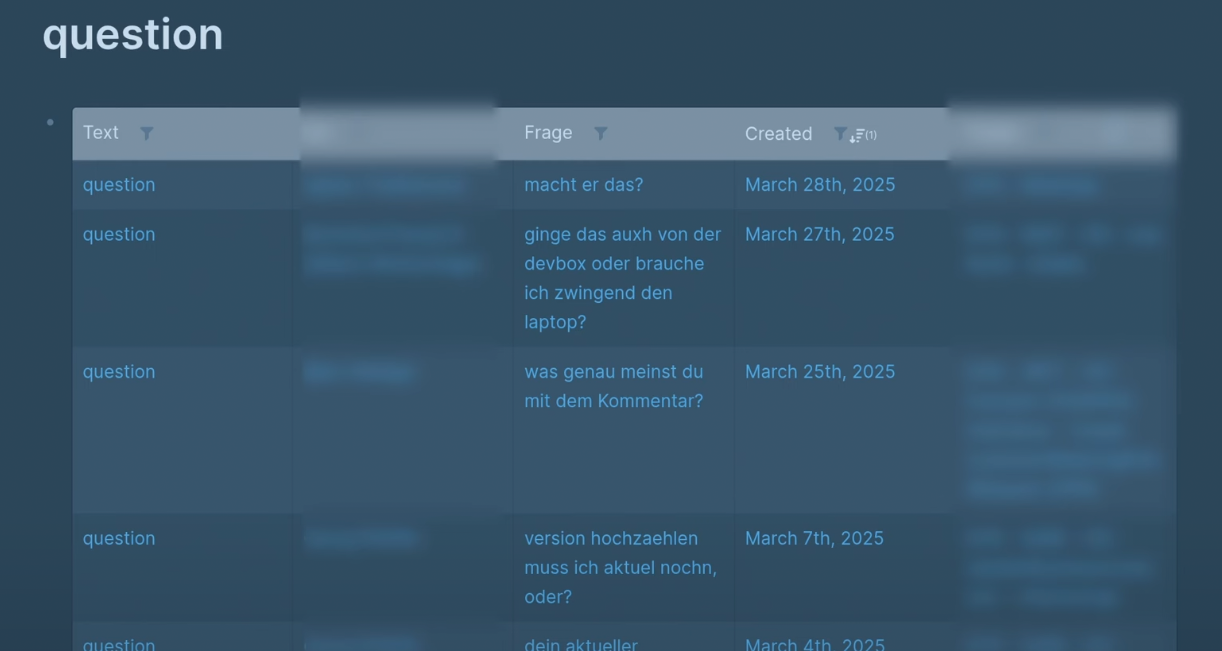
The number of open questions doesn't matter. It can be 5 or 150.
This is because every question contains the full context of
-
why the question was asked (origin)
-
who is to ask / has to answer it
-
how has it been answered
-
what are the next steps
Therefore subwork enables me to know exactly what to do and why. In an instant. With all the information I need to finish my ticket.